The Realities of Structural Drying Timelines
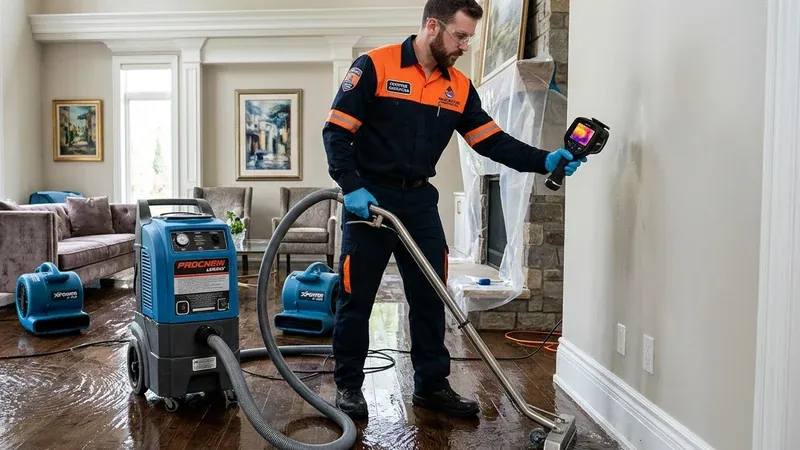
One of the most common questions property owners ask when emergency drying equipment arrives is: "How long will these loud fans and dehumidifiers need to run in my home?" While surface moisture may appear dry to the touch within 24 hours, thorough structural drying of internal framing studs, subfloors, and concrete typically requires between three to five days under commercial psychrometric management.
Day 1: Emergency Extraction and Moisture Mapping
The first twenty-four hours are dedicated to mechanical bulk water removal. High-powered truck-mounted extractors pull hundreds of gallons of free-standing liquid from floors. Technicians take baseline thermal imaging scans and use deep-probe moisture meters to establish unaffected dry standard baselines. Low-grain refrigerant (LGR) dehumidifiers and high-velocity axial fans are positioned to begin forced evaporation.
Days 2 to 3: The Peak Evaporation Phase
During the second and third days, the drying system extracts bound moisture trapped deep inside wood fibers, subfloor layers, and drywall gypsum. The air movers blow high-speed laminar airflow across surfaces to break the boundary layer of saturated air, while commercial dehumidifiers condense dozens of gallons of water vapor into discharge drains daily. Technicians adjust air mover angles and record psychrometric readings every 24 hours to ensure steady humidity reduction.
Days 4 to 5: Equilibrium and Hard-to-Dry Assemblies
By day four, standard drywall and framing studs frequently approach their target moisture content (typically below 12% to 15% wood moisture equivalent). Dense materials such as doubled-up sill plates, hardwood floorboards, and concrete basement slabs may require an additional 24 to 48 hours under specialized vacuum floor mats or injectidry manifolds.
Factors That Influence Drying Duration
Several environmental and structural variables impact the speed of the drying cycle:
- Indoor Temperature – Warm ambient air holds more moisture than cold air, allowing dehumidifiers to extract water vapor more efficiently. Maintaining indoor temperatures between 70 and 85 degrees Fahrenheit optimizes commercial drying fleets.
- Material Density – Multi-layer subflooring and masonry require considerably longer drying intervals than standard fiberglass insulation and drywall.
- Outdoor Relative Humidity – In humid coastal climates, closed-system drying with high-performance LGR units is essential to prevent moist outside air from re-saturating the building envelope.
The Danger of Premature Equipment Removal
Turning off industrial air movers or dehumidifiers before certified moisture targets are met allows remaining moisture pockets inside wall cavities to equalize outward, leading to buckling baseboards, peeling paint, and hidden mold blooms behind walls weeks later. Always wait for technicians to conduct final electronic moisture verification before taking down mitigation equipment.
Experiencing an Active Water Emergency?
Do not let water sit in your home or business. Call our nationwide dispatch desk to coordinate emergency water extraction and structural drying.
Call (855) 563-0161